Category Archives: Wood
July 5, 2013 ITEM 61: NOW PLAYING LP


After the surprising success of ‘ITEM 17 Now Playing’ comes ITEM 61 Now Playing LP. Item 17 was a CD case display that turned out to be very handy and commented on with approval by many! I was subsequently on the lookout for an appropriate piece of drift or street wood to do an upscale version for LPs.
I came across this wedge of tree trunk, chainsaw cut on the perfect angle with the heart wood core creating a great form across the face (looks a bit like the soccer world cup trophy). The sides were hit with a stiff brush only and the face orange spray coloured then sanded back. Some dry rot was drilled out and wax filled in black and orange. Two holding pegs were doweled into the final varnished face. Much work went into a base stand that in house design control advised against using in the end. Even more so than CDs it is an opportunity to display album cover artwork as a rotating exhibition.
Tags: Beach house sculpture, driftwood, flotsam, LPs, Records, repurposed, sculpture, Stereo Hi Fi Gear, street found, street found timber, streetwood, timber restored, vinyl
- Leave a comment
- Posted under Item, Wood
April 1, 2013 Item 60: Cocamaphone 1.25


OK so you’ve got Roland Kirk turned up to 11 on the house system so you can hear it clear out the back where you are in the zone. But your wife and kids are inside becoming emotionally unmanageable because it’s too loud and far out for them. So you sacrifice quality for compromise and take your phone outside to listen to music on that instead. But the zone is a hostile environment and a hot LZ for an iphone. Sun, flying frag, potential toxic fluid flicks and rain drops. Voila, enter the Cocamaphone. Cut the top of a 1.25 litre plastic coke bottle. Has to be Coke shape to get the amplifying funnel acoustics. Bore a hole in the side of the base and insert the top you cut off. Screw the lid back onfrom insideto secure it all and have the top sliced of the lid to allow the sound out. Chuck some paint on the top half for UV barrier. Drill a couple of holes in the fluted base to allow any water out in case of Perfect Storm scenario. Slice rim and fold out as shown to allow stand and added amp. I have been experimenting for a while and it makes a big diff (louder) if the phone speaker is pushed hard to the hack of the Cocamaphone.
The Cocamaphone actually achieves the following with phone inserted:
– Good stability from rolling and knocking.
– Better visibility of phone location (could paint brighter or funkier colour scheme!) and thus reduced inadvertent mech damage.
– Better base vibes and good volume amplification.
– Sun protection.
– Good rain splash and splatter protection. The fluting in the base of PET bottles means any water that gets in will never touch phone before it heads out your drain holes. Don’t forget the drain holes.
– Good buffering from flying and or falling objects.
I devised this DIY quick and cheapie for the workplace but I reckon it would go well at the beach, picnics in the park etc etc.
- Leave a comment
- Posted under Item
March 30, 2013 ITEM 33: Newtown Alps


Lengths of street recovered hardwood decking were re purposed into a bathroom window fascia and in the process of mitering the corners I ended up with all the character packed little triangles of various sizes. It was almost impossible not to fiddle with them and keep reconfiguring them into little arrangements and stacks. I shttps://saltandwood.wordpress.com/?p=1230&preview=trueoon realized they were worthy of being there own item. I varnished the face and painted one edge white.
Tags: Beach house sculpture, design, driftwood, re purposed timber, recycle, sculpture, street found, street found timber, streetwood
- Leave a comment
- Posted under Item, Wood
March 29, 2013 ITEM 16: PHAT JOEL


Who can say where this wedge washed over board or for how long it floated around in the ocean. Sometimes it takes very little to generate something beautiful. Simply trimming the nose square and drilling and doweling a couple of timber pins to compensate for the big centre split (pin striping). The sides and rear retain the character of its travels while the top and bottom were sanded and varnished revealing great character and a beautiful rich golden timber that I have not identified. It also sports an interesting little rebate in one side from some past purpose. It was probably a door jam on a boat. It could be a door jam again or maybe just a sculptural talking piece. Phat Joel because I made it as a request piece for a guy named Joel who is Phat but not fat.
Tags: Beach house sculpture, driftwood, flotsam, re purposed drift wood, re-purpose, recycled, sculpture, timber recycling, timber restored
- Leave a comment
- Posted under Item, Wood
March 21, 2013 ITEM 27: Salt Shelf


Bower (A donated materials and objects enterprise on Addison Road) recovered timber mantle cut and varnished. Bay found flotsam has been doweled to main shelf to create legs.
Tags: Beach house sculpture, driftwood, flotsam, modernist, re purposed timber, re-purpose, street found timber, style, talking point, timber recycling, timber restored
- Leave a comment
- Posted under Item, Wood
March 21, 2013 ITEM 32: DECO


The Inter War Deco Architectural style is a personal favorite of mine and many of the best examples around Sydney are the beautiful pubs built in that style by the hot young Architects of the day and paid for by the cashed up breweries of that era that still owned most of the pubs. Stepped roofs, patterned facades and horizontal patterning, coloured tiles and geometrically even curves reminiscent of the older P&O Liners are but a tad of the magic. This is a little homage I whipped together from these two drawers and various other bits of street and bay found flotsam. Engineering wise this piece is interesting because the drawers are mounted pointing out to the sides. This created all sorts of shenanigans with regard to imagining a sturdy structural compilation. You can see I pushed the 1970’s handles aside for something more befitting the Inter War Deco design objective. These are the same type of handles I salvaged for the Tiki Lounge Key Cabin (a recent post). The paint colours are also intended to be reminiscent of some c1935 pub tile colours.
Tags: Beach house sculpture, design, flotam, Inter War Deco, key cabine, re purposed timber, recycled sculpture, sculpture, street found timber, style, talking point
- 2 comments
- Posted under HQ Cabinet, Item, Wood
January 22, 2013 Item 31: DB 11 5


This was probably a medicine cabinet complete with spilled iodine stains. Guessing from the craftsman’s stamp found under the paint it was put together in either May 1911 or September 1905? By DB? The other mysterious stamp is the ‘HO EC’ on the left side.
I found this in a back lane in Petersham Covered in layers of old paint and full of a colony of insects including Redback Spiders. After some meticulous stick flicking the cabinet was declared non-deadly and mounted on the back of my motorbike with a couple of ocky straps.
Just to be clear this was a rescue mission rather than a sculptural re purposing of accumulated components, as would generally be the intent of the item projects. And thus the character of the piece is more akin to its original intent and crafting some 100+ years ago!
Basically I was able to knock many of the joints apart and give it all a sanding. It still had what are probably the original hinges and screws though the door handle and latch were long gone with the housing rebate the only clue. The inside face of the side walls have multiple shelf slots but only two shelves leading me to guess this is a mass produced component to suit different uses.
The back panel was badly cracked and thus replaced. Where the wood was badly stained for various reasons I spray painted white and set up a contrast with the natural timber grain components. The whole unit seems to be a combination of pine and some sort of White Cedar? I put together an additional component that was fitted into the top rear to stabilize the whole structure and provide a secure mounting area to wall hang the unit. A little extra half shelf was incorporated into this. The white knob was some random street find.
Tags: Beach house sculpture, re purposed, street found, timber, timber recycling, timber restoration
- 3 comments
- Posted under HQ Cabinet, Item, Wood
December 5, 2012 Item 30: Tiki Lounge Key Cabin.


This was a commissioned piece for a surfer, thus the theme of the detailing. Two old drawers (face timber type unknown) and handles restored and doweled together to generate better shelf depth. And a variety of other street and beach found components have been restored and incorporated. From the coloured rope to the airoplane wing legs (note the grain in this unknown timber) to the islander detail trim from the edge of a little abandoned table to the shelves and horizontal rod hangers. The internal sides and back panel were spray painted blue in keeping with the ocean theme. The back of the drawer faces (now the ceiling) has been left as found to incorporate a bit of the history of the components. The shelf ledges are timber doweled to the sides of the unit generating these tidy little circle details on the outside faces as a counterpoint to the already interesting pine grain formations. This is also the first time I have finally incorporated some of the electric detail that has been a long time evolving in the SALTANDWOOD sketchbooks. With the components picked up from a Jaycar electronics shop. The retro switch was a purchase not a find. But I am on the lookout for some switches to re purpose! So this is AA battery powered (mounted behind the shelf ledge) and the little night access light can be turned on independently for the upper or lower shelf.
The top shelf is designed with a smooth top edge to aloe wallets and phones to slide easily in and out. The bottom shelf has the upturn to allow a build up of secondary items and bits and pieces/ coins etc without spilling out. The bottom shelf also has a newly developed feature in the ‘double entry lip’ that provides a spot for say a pen or zip stick not getting lost in the tray. This particular commission also came with a request for a place to hang a hat at the end of the day and you can see here the protruding disc that facilitates this. It is made (as was the switch mounting) from the second drawer backing that was removed and some found pine rod that can be popped out left or right if the unit goes up against a wall on one side. I also added some beautiful molded hooks that I coincidentally found in an abandoned cupboard (circa 1930s?) a few day before and restored well in a jewelry cleaning solution.
You can see the rear of the unit was finished of in a particular way for a bit of fun and colour and is slid in and held with a removable dowel peg if need be.
Tags: key cabine, re-purpose, timber restored
- 1 comment
- Posted under HQ Cabinet, Item, Salt, Wood
October 19, 2012 ITEM 20: Met the Jetsons


This piece of ply with cedar (?) spine was found among the rocks along Botany Bay. It seems like it was some type of storage box cover off a boat. The sea had honed it to a clichéd modernist trapezoid shape. I lightly sanded the underside to remove lose flakes but retain the paint history then stamped and varnished it. The top side ply was not that attractive after cutting and varnishing so it was attacked with the bright gloss orange paint to great effect. The legs were rescued from a table thrown on the street near Enmore road and simply sanded back and oiled. With the internal corner mounting brackets also rescued and reemployed into this item. The timber bracing is cut from two pieces of restored beach found timber. Also likely off a boat given the strong and light nature of this timber (?). The timber bracing was chiseled into the legs. And the little spine cut into the bracing. The odd height proportion is a comfortable standing use table. Say for drinks at a party.
Tags: Beach house sculpture, modernist, re-purpose, recycle
- Leave a comment
- Posted under Item, Wood
October 1, 2012 Item 29: Long Toe


This hardwood wedge was found washed up along Botany Bay. It is interesting for its long concave elf shoe proportion and was just a sanding and varnishing exercise to bring out its inner beauty. It now takes pride of place as our front door wedge.
Tags: Beach house sculpture, re purposing, sculpture, talking point
- Leave a comment
- Posted under Item, Wood
September 30, 2012 ITEM 28: SEA LEGS


A Eucalyptus plank washed up after the big storms that swept Sydney in August 2011. It looked like it had been in the sea for a while and before that used as some sort of paint or resin mixing block on a boat. Two things struck me. The satisfying proportions of the block and the thick blue and black colour of the dried substance spilled across it. I immediately had an urge to expose some surfaces and retain others to bring out this contrast. The top is clean sanded and oiled to allow use as a food surface. One edge was very lightly sanded and then stiff brushed to clean but retain the paint texture and colours. The back edge was clean sanded and holes wax filled. The base just lightly sanded but kept pretty much rough sawn finish. Some of the bigger top cracks were filled with wood putty to smooth it out for food, cheese and crackers etc. All except the top are varnished finished and finally a batch of found bright orange fishing floats were utilized to create legs to stand the whole thing off the table. All in all the timber, blue paint and orange legs visually vibrate very well.
- Leave a comment
- Posted under Item, Wood
July 26, 2012 Item 25: LD2


Long drawer was the first item posted on this blog. It had a brother piece that was found with it and has now finally been converted into a companion CD shelf. Unlike Long Drawer one that was shelved with sides from other drawers, this one is shelved with restored driftwood boards and has a white painted internal surface rather than the paper lining.
Tags: driftwood, re purposed timber, recycled, street found, streetwood, timber recycling
- Leave a comment
- Posted under HQ Cabinet, Item, Wood
July 26, 2012 ITEM 26: Ratio 3 to 1


This 4 drawer modern beauty on legs was discovered on the streets of Surry Hills in May 2012. A Circa 1965 piece? It was complete with all drawers and these stunning concave copper handles. Except, frustratingly ‘1’ of them. Even the screw was still in place. So as you can see the 4th or bottom handle is a ring in from another street find. The handles and chrome socks were removed and the entire unit was cut back to timber. Then the sides and front were given a fresh coat of gloss white. With the legs, drawer faces and top of the unit retained as exposed timber and varnished. The drawer internals were spray painted bright orange and the fittings all cleaned and reattached.
Tags: recycled, repurposed, street found, timber recycling
- Leave a comment
- Posted under Item, Wood
June 30, 2012 Item 17: Now Playing


This largish wedge of timber was found along Yarra Bay. The unidentified species has a definite satin to it but seems to soft to have been a chock from a ship. More likely an off cut from work somewhere around the Bay or beyond. The front pegs and legs are all dowel found around the bay, cut to size and varnished or painted with a tin of gloss red enamel paint found in the street and add that certain ‘maritime petroleum exploration oil rig architectonic’. Despite drawing gentle ridicule from all observers this item has proved surprisingly useful for locating the cover of the playing CD. This may have been the tipping point for my wife’s comment “this corner of the lounge room is looking like a 1970’s JB HiFi.” Despite my initial reaction it turned out this was not complimentary!
- Leave a comment
- Posted under Item, Wood
June 11, 2012 ITEM 24: Hang Ten


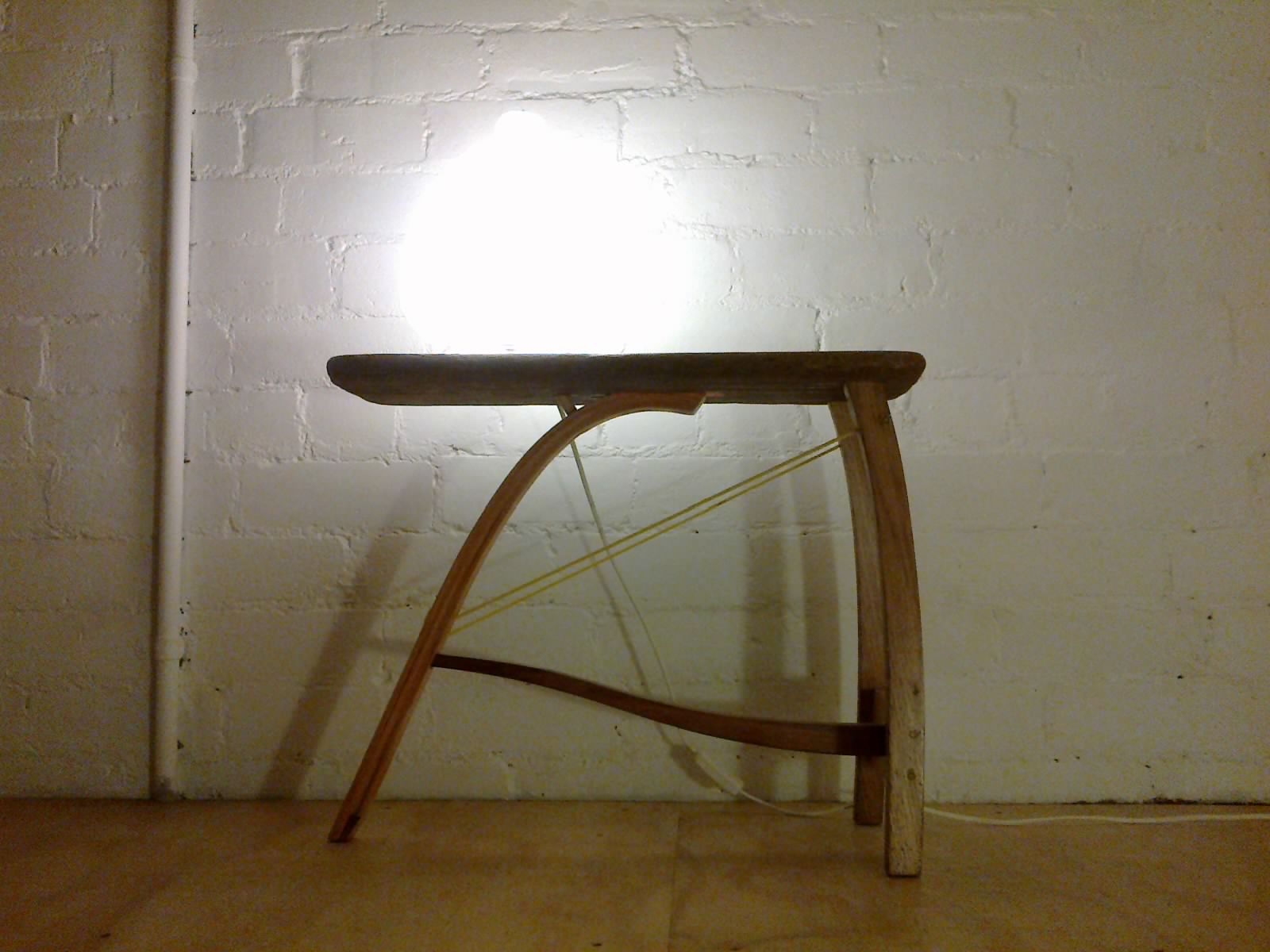
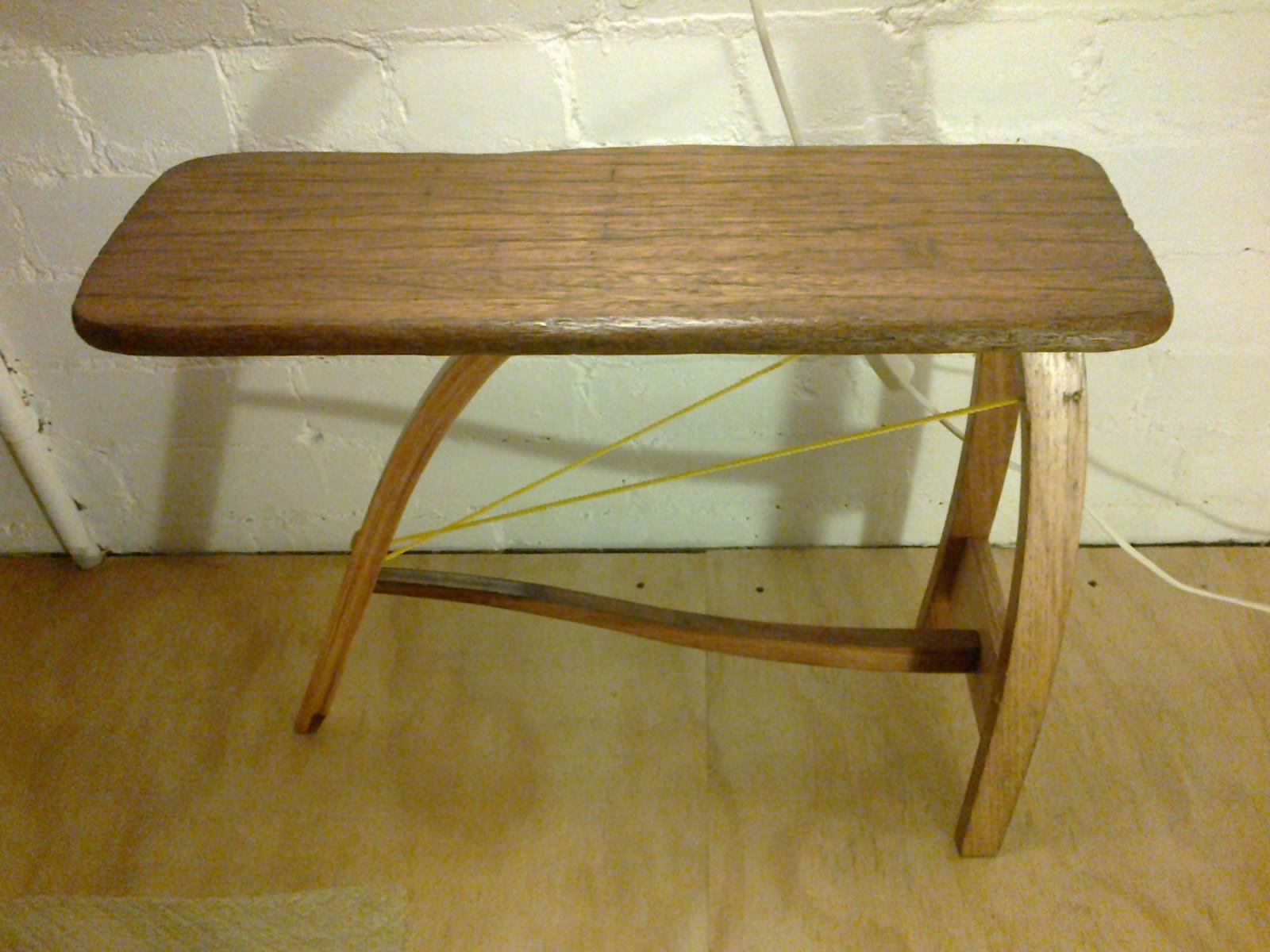

This three-legged marvel of odd engineering was the composite result of a variety of curved timber off cuts and finds. All the timber was street or beach recovered and the yellow rope was donated by a friend from their shed clean up. The little front to back cross-timber is something like Rosewood that was washed up north of Sydney near Fishermen’s Bay. I cut the mortise in adjoining timber to take the existing tenon. The two rear legs are from and old timber chair that was previously restored from the street but finally gave in! You can see the combination load bearing system of the rope and timbers from the side view. The rope end knots are waxed into existing holes that were drilled into the old chair legs. I am not sure what the deck timber is but it came up beautifully.
Tags: flotsam, lamp table, recycling, rope bracing
- Leave a comment
- Posted under Item, Wood
 salt and wood